

Ever run an experiment, crunch the numbers, and wonder how close your result really is to the correct value? That’s where how to calculate percent error comes in. Whether you’re working through a chemistry lab, a physics problem, or a spreadsheet in Excel, percent error helps you measure accuracy in a clear, meaningful way.
In this guide, we’ll break down percent error in plain English, walk through practical examples, and show you how to calculate percent error in chemistry, physics, and Excel—without making your head spin.
What Is Percent Error?
Percent error measures how far your experimental or measured value is from the accepted (true) value. Instead of just saying, “I was off,” percent error tells you how much you were off in percentage terms.
It’s widely used in:
-
Science labs
-
Physics experiments
-
Engineering calculations
-
Data analysis and reporting
The smaller the percent error, the more accurate your result.
The Percent Error Formula Explained
Before jumping into examples, let’s look at the standard formula used across science and math.
Percent Error Formula
Percent Error=∣Experimental Value−Accepted Value∣Accepted Value×100\text{Percent Error} = \frac{|\text{Experimental Value} – \text{Accepted Value}|}{\text{Accepted Value}} \times 100
What Each Term Means
-
Experimental Value: The value you measured or calculated
-
Accepted Value: The known or true value
-
Absolute Value (| |): Ensures the result is positive
This formula stays the same whether you’re learning how to calculate percent error in chemistry, physics, or Excel.
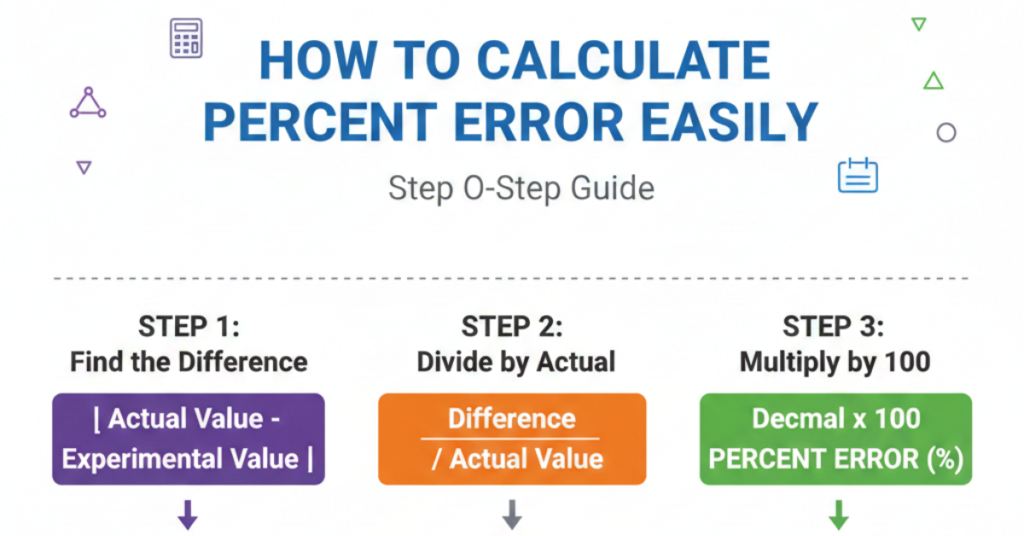
How to Calculate Percent Error Step by Step
Let’s simplify the process into clear steps you can use every time.
Step 1: Subtract the Values
Subtract the accepted value from the experimental value.
Step 2: Take the Absolute Value
Ignore negative signs by taking the absolute value.
Step 3: Divide by the Accepted Value
This normalizes the difference.
Step 4: Multiply by 100
Convert the result into a percentage.
Example: Basic Percent Error Calculation
Let’s say:
-
Experimental value = 47
-
Accepted value = 50
Calculation:
-
47 − 50 = −3
-
|−3| = 3
-
3 ÷ 50 = 0.06
-
0.06 × 100 = 6%
Percent error = 6%
How to Calculate Percent Error in Chemistry
In chemistry, percent error often shows up in lab experiments when comparing measured results to known constants.
Chemistry Example
-
Measured molar mass = 62 g/mol
-
Accepted molar mass = 60 g/mol
∣62−60∣60×100=3.33%\frac{|62 – 60|}{60} \times 100 = 3.33\%
A low percent error like this usually indicates good experimental technique.
Tip: Lab instructors often look at percent error to evaluate accuracy—not just final answers.
How to Calculate Percent Error in Physics
Physics experiments deal with motion, force, energy, and time, making small measurement errors common.
Physics Example
-
Measured acceleration = 9.5 m/s²
-
Accepted acceleration (gravity) = 9.8 m/s²
∣9.5−9.8∣9.8×100=3.06%\frac{|9.5 – 9.8|}{9.8} \times 100 = 3.06\%
Knowing how to calculate percent error in physics helps you judge whether your setup or instruments introduced errors.
How to Calculate Percent Error in Excel
Excel makes percent error calculations fast and repeatable—especially useful for large datasets.
Excel Formula
If:
-
Cell A2 = Experimental Value
-
Cell B2 = Accepted Value
Use this formula:
Why Excel Is Useful
-
Reduces manual calculation mistakes
-
Ideal for lab reports and data analysis
-
Easily copied across multiple rows
This method is perfect for students and professionals learning how to calculate percent error in Excel efficiently.
Common Mistakes to Avoid
Even though the formula is simple, mistakes happen. Watch out for these:
-
Forgetting the absolute value
-
Dividing by the experimental value instead of the accepted value
-
Skipping the multiplication by 100
-
Confusing percent error with percent difference
Avoiding these errors keeps your results accurate and credible.
When Should You Use Percent Error?
Percent error is best used when:
-
A known or accepted value exists
-
You’re evaluating experimental accuracy
-
Comparing lab or field results
If no accepted value exists, percent difference may be a better choice.
FAQs About Percent Error
What is a good percent error?
It depends on the field. In controlled lab experiments, under 5% is often considered good. In real-world measurements, higher values may still be acceptable.
Can percent error be zero?
Yes. If the experimental value equals the accepted value exactly, percent error is 0%.
Is percent error always positive?
Yes. The absolute value ensures the result is never negative.
What’s the difference between percent error and percent difference?
Percent error compares a value to a known standard. Percent difference compares two measured values when no accepted value exists.
Why is percent error important in chemistry and physics?
It helps evaluate accuracy, identify sources of error, and improve experimental methods.
Conclusion: Mastering Percent Error Made Simple
Understanding how to calculate percent error gives you a powerful tool for measuring accuracy across chemistry, physics, and data analysis. Once you know the formula and follow the steps carefully, percent error becomes quick, intuitive, and incredibly useful. If you’re working on lab reports, experiments, or spreadsheets, try applying these examples to your own data. For deeper learning, explore related topics like percent difference, uncertainty analysis, or error propagation.